



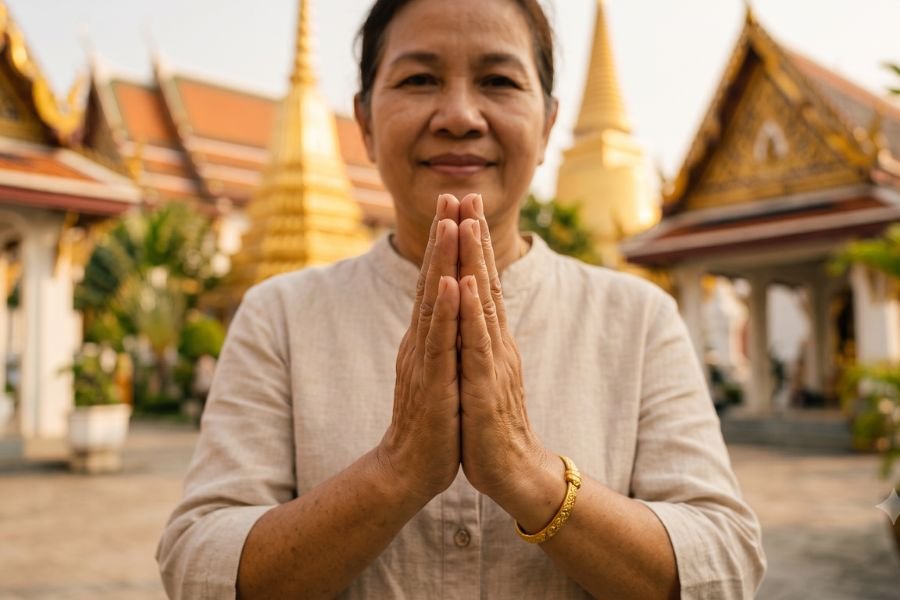
Etiquette in Thailand rests on three pillars: respect for the monarchy, the Buddhist religion and keeping your emotions in check in public. Understand those three and almost every unwritten rule follows from them.
Thailand, a constitutional monarchy in Southeast Asia, is a tolerant country with its visitors. Some mistakes, though, are not simple bad manners: they are criminal offenses.
📍 Checked in July 2026 by our team, who live and work in Thailand.
Table of contents❯
Thailand Etiquette at a Glance: The Rules That Matter
The rules that really count are few, and you can learn them in five minutes.
What to Do and What to Avoid: The Quick Table
Thai etiquette comes down to a handful of paired behaviors. The table covers the situations a traveler runs into most often.
| Situation | What to do | What to avoid |
|---|---|---|
| Greeting | A wai, or a nod of the head with a smile | An insistent handshake, a pat on the back |
| Monarchy | Silence, respect, standing for the royal anthem | Jokes, comments, irreverent photos |
| Temple | Shoulders and knees covered, shoes off | Tank top, short shorts, a loud voice |
| Monks | A respectful distance, offerings set down | Physical contact, above all from a woman |
| Disagreement | Calm tone, a smile, never in public | Raising your voice, demanding an apology in front of others |
| Money | Banknotes handled with care | Stepping on a banknote that has fallen |
| Feet | Tucked behind you when seated | Pointed at people, statues or food |
| On transport | Low voice, orderly queue | Eating, drinking, taking loud calls |
The Wai: How People Greet Each Other in Thailand
The wai is the Thai greeting: the palms are pressed together in front of the chest and the head bows slightly. It is not a religious gesture, it is everyday courtesy.
The height of the hands signals the degree of respect. The younger person, or the one in the junior position, offers the wai first, and the other returns it.
That is why a visitor should not wai a waiter or a taxi driver: the gesture embarrasses whoever receives it. A smile and a nod of the head are enough, and the wai is gladly returned when someone else offers it first.
Wai heights and who starts it
The fingertips reach chin height. This is the most common wai, the one you see all day long.
The fingers rise to nose height and the head bows a little further. The same applies to a senior colleague at work.
The fingers reach the forehead. The same height is used before an image of the Buddha and inside places of worship.
A child is not answered with a wai, but with a smile. The gesture follows the hierarchy of age.
If your hands are busy, a nod of the head on its own will do. Nobody takes offense.
You hand over and receive with the right hand, often supporting the elbow with the left. Pointing an index finger at a person is rude: point with an open hand.
Respect for the Monarchy: The Most Serious Rule
Criticizing or mocking the Thai royal family is a criminal offense, not a breach of manners. Section 112 of the criminal code covers lèse-majesté and carries three to fifteen years in prison, counted separately for each charge. It applies to foreign visitors too, as government travel advice makes clear: see the UK Foreign Office advice on Thailand, and check the advisory published by your own government before you fly.
There is no exception for a joking tone, for a private setting or for social media. Even a post published years earlier, in another language, can be raised against you.
In daily life the rule turns into concrete gestures:
- Banknotes and coins carry the image of the sovereign: they are not stepped on and not torn.
- In cinemas the royal anthem is played before the film: everyone stands up.
- In stations and parks the national anthem sounds at 8:00 a.m. and 6:00 p.m.: anyone walking past stops.
- Royal portraits displayed in the street and in shops are not used as a backdrop for ironic photos.
In Temples: Dress Code and Behavior
Entering a Buddhist temple requires shoulders and knees covered, and shoes taken off at the door. The busiest sites, such as the Grand Palace in Bangkok, turn away anyone who arrives in a tank top or short shorts.
A sarong is not always accepted in place of trousers. Many temples rent out a cover-up at the entrance, but not all of them: a scarf or a pair of light trousers in your bag saves any surprise.
The rules inside the temple
Shoes stay outside. The raised threshold is stepped over, never trodden on: tradition holds that spirits live in it.
You sit with your legs folded to one side and your feet turned backwards, never pointing at the image of the Buddha.
You do not climb on statues and you do not rest a hand on a Buddha for a photograph.
Turning your back on a sacred image to take a selfie is considered disrespectful.
You do not walk in front of someone who is praying and you do not raise your voice, not even in the outer courtyards.
Flowers, incense and gold leaf are bought on site, and a free donation is left in the boxes provided.
How to behave around monks
Buddhist monks follow rules of conduct that involve the people they meet as well. They wear orange robes and are held in high social regard.
A woman must not touch a monk or hand him an object directly: the object is placed on a cloth or a surface, or passed on through a man. On public transport the front seats are reserved for monks and are left free.
The morning food offering, the tak bat, is watched barefoot and in silence. To take a photograph, ask first with a gesture.
Head and Feet: The Two Ends of the Body
In Thai culture the head is the noblest part of the body and the feet the lowest. A great many everyday rules come down from that symbolic scale, which has Buddhist roots.
| Situation | The head | The feet |
|---|---|---|
| Contact | Nobody's head is touched, children included | You never brush against a person with your foot, not even as a joke |
| Objects | Nothing is passed over the head of someone sitting down | You do not point at an object or move it with your foot |
| Sitting on the floor | Your head stays lower than a monk's or an older person's | Legs folded to one side, feet turned backwards |
| In sacred places | Hat and sunglasses come off at the entrance | Shoes stay outside and the raised threshold is stepped over |
| At home and on transport | - | They do not go on seats, tables or handrails |
Jai Yen: Why Nobody Raises Their Voice in Thailand
Jai yen means cool heart, and it is the Thai ideal of behavior: staying calm whatever happens. Its opposite, jai ron, describes someone who heats up and loses control.
Raising your voice does not solve a problem, it makes it worse. Whoever gets angry in public makes the other person lose face and, in the eyes of everyone watching, loses it first.
A Thai smile does not always mean cheerfulness. It can express embarrassment, an apology or unease. In the same way mai pen rai, never mind, closes a matter without resentment.
What our team sees every day: complaints work far better raised in private with the manager, never in front of other guests or colleagues.
In Public and on Transport: The Rules of Quiet
Eating and drinking, water included, are forbidden on the BTS Skytrain and the MRT in Bangkok. Phone calls are kept short and quiet.
People line up along the markings on the platform and let passengers off before boarding. The queue is respected at the convenience store and the ticket counter too.
The front seats belong to monks, older people, pregnant women and passengers with disabilities. They stay empty even in a packed carriage.
A backpack is held in your hand or in front of you, never on the seat next to you. Feet do not go on seats or handrails.
Both go through headphones. Speakerphone and videos without earphones are seen as bad manners.
The national anthem plays in stations, parks and public spaces. Anyone walking stops and stands still until it ends.
A complaint is made in private and in a steady voice. Raising your tone in front of others closes the conversation instead of unlocking it.
At the Table: Thai Dining Etiquette
Thai food is eaten with a spoon and a fork: the spoon goes to your mouth, the fork only pushes food onto it. Chopsticks are used for noodles and for dishes of Chinese origin.
Dishes arrive in the middle of the table and are shared. You help yourself a little at a time onto your own plate of rice, using the serving spoon when there is one.
Sticky rice from the North and from Isan is eaten by hand, rolled into a small ball with the right one. Chopsticks are never left standing upright in rice: it recalls a funeral rite.
As a rule the person who invited pays, and the bill is not split item by item. Blowing your nose at the table is considered unpleasant.
How to Dress Outside the Temples
Away from places of worship what you wear is up to you, but topless sunbathing is illegal on every Thai beach. The law provides a penalty, and in the busier resorts it really is enforced.
Walking around bare-chested off the beach, in convenience stores, restaurants or on transport, is frowned upon everywhere. Swimwear stays on the sand.
In government offices, hospitals and at immigration, tidy clothing makes every procedure easier. Public displays of affection are tolerated in tourist areas, far less so in villages and in the mainly Muslim southern provinces.
Tipping in Thailand: How Much, and Who To
Tipping in Thailand is not compulsory and Thai people rarely tip each other, but in tourism it has become common practice. Wages in the sector are low, and a modest amount makes a real difference to a monthly income.
How much depends on the place. In a neighborhood restaurant or at a street stall, 20 baht is already a fair tip. In a tourist or upmarket restaurant around 10% is usual, once you have checked that a service charge is not already on the bill.
With Grab and Bolt a tip is worth more than it looks. App fares are low to begin with and the commission taken from the driver is high: the figure on your screen is not what the driver ends up with. Rounding the fare up, or adding around 30% of the price, is much appreciated.
A guide and a driver on a tour are also tipped at the end of the day as a rule, with the larger share going to the guide.
One and two baht coins left on the table, on the other hand, are taken as an insult: better nothing at all than a token amount.
How much to leave: rough figures
Rough figures collected by our team in July 2026. They are not rates: a tip stays free and in proportion to the service you received.
| Situation | Rough amount | Note |
|---|---|---|
| Local restaurant or street stall | 20 baht | Enough, and always appreciated |
| Tourist restaurant | Around 10% | Many places already add a 5-10% service charge |
| Grab or Bolt ride | Round up, or +30% | The commission taken from the driver is high |
| Metered taxi | Round the fare up | With an agreed fare you add nothing |
| Tuk-tuk at a negotiated price | Nothing | The price has already been bargained |
| Hotel porter | 20-100 baht | For carrying the luggage |
| Traditional massage | 50-100 baht | On a standard treatment |
| Guide on a tour or day trip | 200-500 baht per day | About half that for the driver as a rule |
Laws That Catch Travelers Out
Some Thai rules have no equivalent back home and are enforced strictly, foreign visitors included. The main ones cover smoking, e-cigarettes, cannabis and alcohol.
The penalties are spelled out in government travel advice and in the announcements of the Tourism Authority of Thailand. The fact that a product is easy to find locally does not make it legal to buy.
The bans worth knowing about
E-cigarettes: banned
Possession, use, sale and import of e-cigarettes are banned in Thailand, disposable devices and heated tobacco products included. The penalty is a fine of five times the value of the item, with confiscation and possible imprisonment.
Our team’s advice is to leave them at home: the rule applies to devices bought locally as well.
Smoking on beaches and in public places
Smoking has been banned on many Thai beaches since 2018, and in all enclosed public places. Penalties reach 100,000 baht and up to one year in prison.
Airports and many venues have marked smoking areas.
Cannabis: prescription only
Since 2025 cannabis flower has been classified as a controlled substance: buying and possessing it require a medical prescription issued in Thailand. Recreational use is not allowed, and the network of open shops is shrinking.
The rules in force are summarized by the Tourism Authority of Thailand.
Alcohol: hours and public holidays
The rules on selling hours were reformed recently and the afternoon window that used to be closed has been removed. Bans remain on the main Buddhist holidays and on election days.
The minimum age to buy is 20, and penalties for drink-driving are severe, with possible deportation for foreign nationals.
Images of the Buddha
Exporting images and statues of the Buddha requires a permit. Tattoos showing the face of the Buddha on the lower body are considered offensive and have already caused problems on arrival in the country.
Drones and photography
Drones have to be registered with the Thai authorities before use. Photographing people, and monks and religious ceremonies in particular, should always be asked for with a gesture.
Festivals and Special Occasions
Songkran, the Thai New Year
Songkran usually falls in mid-April and is celebrated by throwing water in the streets all over the country. It began as a blessing, not as a battle.
You do not soak monks, older people, babies or anyone riding a scooter. Ice in the buckets and high-pressure water guns are best left alone.
Loy Krathong, the festival of floating rafts
Loy Krathong falls in November, on a date set by the lunar calendar, and fills rivers and canals with small rafts of flowers and candles.
Polystyrene versions are banned in many provinces by now: choose a krathong made of banana leaf or bread.
Buddhist holy days and national mourning
On the main Buddhist holidays alcohol sales are suspended and temples fill with worshippers. It is the best moment to watch the traditions from close up, in silence.
During national mourning people wear sober colors and noisy events are called off. Hotels and local authorities pass on the instructions.
Mistakes to Avoid
Joking about the monarchy
Even a harmless quip about the King or a member of the royal family can cost you criminal proceedings. No setting is informal enough.
Entering a temple in a tank top
Bare shoulders and knees will keep you out of the main sites. A light layer in your bag solves the problem.
Raising your voice to complain
A heated tone stops the conversation instead of speeding it up. In Thailand polite firmness gets you much further.
Touching a child's head
In much of the West it is the most natural affectionate gesture there is. Here it is a taboo: heads are not touched at any age.
Bringing an e-cigarette
This is the single mistake that causes visitors the most trouble. The law bans them and it is enforced for real.
Talking loudly on public transport
Thai metros, trains and ferries are quiet places. A group chatting at volume is noticed at once, and not in a good way.
Taking photos without asking
Monks, ceremonies and local markets are not a film set. A nod with the camera is enough to ask permission.
Handling baht carelessly
Banknotes that are stepped on or crumpled offend the royal image printed on them.
Frequently Asked Questions About Thailand Etiquette
Do visitors have to wai in Thailand?
No, a visitor is not expected to wai. The gesture follows a precise social hierarchy, and a tourist who offers it to service staff puts the person receiving it in an awkward position.
A smile with a nod of the head is always appropriate. The wai is gladly returned when somebody else offers it first, at a hotel entrance for example.
What happens if you speak badly of the Thai monarchy?
You risk criminal proceedings for lèse-majesté. Section 112 of the criminal code carries three to fifteen years in prison, counted separately for each charge, and it applies to foreign nationals too.
Social media comments, irreverent photographs and jokes made in public all fall under it. The practical rule is simple: the royal family is not a subject for jokes or for debate.
What should you wear to visit a temple in Thailand?
To visit a temple you need shoulders and knees covered, and shoes you can take off at the door. Long trousers or a skirt below the knee and a top with sleeves are fine.
The major sites, such as the Grand Palace in Bangkok, check at the entrance and in some cases rent out a cover-up. Carrying a scarf in your bag saves any surprise.
Are e-cigarettes really banned in Thailand?
Yes, e-cigarettes are banned in Thailand. The ban covers possession, use, sale and import, and it includes disposable devices and heated tobacco products.
The penalties include a fine of five times the value of the device, confiscation and possible imprisonment. The fact that they are easy to find locally does not make them legal.
How much do you tip in Thailand?
Tipping in Thailand is not compulsory and there is no expected percentage: it depends on the kind of place. In a neighborhood restaurant 20 baht is fine, while in a tourist restaurant 10% is usual if a service charge is not already on the bill.
With ride-hailing apps such as Grab and Bolt a tip is particularly welcome, because the commission taken from the driver is high: rounding up or adding around 30% of the fare makes a real difference.
Can you eat on the Bangkok metro?
No, eating and drinking are not allowed on the Bangkok metro, water included. The ban covers both the BTS Skytrain and the MRT and is signposted at the entrance of every station.
On board you also keep your voice down and leave the seats reserved for monks, older passengers and pregnant women free.
Why are feet considered impure in Thailand?
Feet are held to be the lowest part of the body in the symbolic scale of Thai culture, which has Buddhist and Indian roots, while the head occupies the highest place.
From that come the rules against pointing your feet at people or sacred images, resting them on seats and moving objects with them. Sitting on the floor, the correct position keeps the legs folded to one side, with the feet turned backwards.
Is etiquette the same across the whole of Thailand?
No, customs vary from region to region. The North around Chiang Mai keeps more formal forms of courtesy and Lanna traditions of its own.
The South, and the mainly Muslim border provinces in particular, calls for more care over clothing and alcohol. Big cities and tourist islands are the most relaxed areas, but the rules on the monarchy, temples and monks apply everywhere in the same way.
In Short
Etiquette in Thailand comes down to a few rules that are easy to remember. Absolute respect for the monarchy and for religion, covered clothing in temples, head high and feet low, calm and a low voice in any disagreement.
The laws worth knowing before you fly cover e-cigarettes, smoking, cannabis and alcohol: they are the most enforced and the most underestimated.
The rest you pick up by watching. Thai people readily forgive a mistake made by someone who is clearly trying to behave well.
Sources and updates
The information in this guide was checked in July 2026 against official sources. Thai rules change often: before you leave it is worth going back to the official pages.
- UK Foreign Office · Thailand travel advice
- Ministry of Foreign Affairs of the Kingdom of Thailand, consular information
- Tourism Authority of Thailand, official newsroom
This guide may contain affiliate links: if you book through one of them, nothing changes for you, while we receive a small commission from the booking platform, which repays the time spent writing and updating this guide. More information.