



Table of contents❯
Which Bangkok Neighborhood Is Right for You?
Still planning and not sure which Bangkok neighborhood to stay in, or what to expect from each area? This guide has what you need: the best-known districts, what to see in each one, how to get around and who each area suits.
At a Glance:
- For temples and history → Phra Nakhon
- For nightlife and an international crowd → Sukhumvit
- For street food and creative chaos → Chinatown & Charoenkrung
- For transport on the doorstep → Siam or Silom
- For slow, canal-side character → Thonburi
Bangkok is an enormous city, and every area has its own character, pace, sound and smell. You can go from an 18th-century gilded temple to a rooftop cocktail bar on a glass tower in twenty minutes. You can wake up to monks chanting and fall asleep to the neon of a street that never shuts.
Bangkok is also known for its traffic. That is exactly why picking the right neighborhood to stay in, or simply knowing what each area is like, makes the difference between a trip that flows and one spent sitting in a taxi.
All the Main Bangkok Neighborhoods: Overview and Quick Comparison Table
| Area | Best for | Vibe | Main transport link |
|---|---|---|---|
| Phra Nakhon | History, temples, first visit | Historic and lively | River boat (Tha Chang pier) |
| Chinatown & Charoenkrung | Street food, photography, art | Chaotic and creative | River boat / MRT Hua Lamphong |
| Sukhumvit | Expats, nightlife, comfort | Modern and international | BTS (the whole line) |
| Bang Rak & Silom | Business, nightlife, convenience | Two personalities | BTS Sala Daeng / MRT Silom |
| Sathon | Couples, high-end stays, quiet | Elegant and residential | BTS Saphan Taksin |
| Thonburi & Khlong San | Local character, canals, photography | Slow and genuine | River boat from Central Pier |
| Siam & Pratunam | Shopping, families, transport links | Fast and commercial | BTS Siam (central hub) |
| Ari / Bang Krachao / Koh Kret | Local life, nature, crafts | Creative / green / rural | BTS / boat |
The Chao Phraya River, the thread that ties Bangkok's neighborhoods together
Before we get to the districts, there is one thing to understand about Bangkok: the Chao Phraya River is its backbone.
Known as the River of Kings, the Chao Phraya runs through the city from north to south and links the most striking parts of the Thai capital. It is not just scenery: it is a working transport network, and it is often faster, and far better looking, than any taxi or train.
Along the Chao Phraya You Will Find:
- The historic temples of Phra Nakhon (Grand Palace, Wat Pho, Wat Arun)
- Talat Noi, Chinatown and the creative Charoenkrung quarter
- The Sathon and Bang Rak piers, where the express boats leave for almost every corner of the city
- The Thonburi banks, with their quiet canals and stilt houses
- The grand riverfront luxury hotels, among the finest in Asia
Using the river to get around
The public Chao Phraya Express boats (you can tell them apart by the colored flags on the hull) are cheap, punctual and cover the whole urban stretch. The main pier is Sathorn/Central Pier, an easy walk from BTS Saphan Taksin.
For the inner canals of Thonburi you can hire a private long-tail boat or a water taxi, something that earns its place in the plan on its own.
Practical tip: If you are still choosing a hotel and want the most freedom to move, pick one near a main pier. The temples, Chinatown and Sathon are minutes away, with no traffic in between.
Read Where to Stay in the Riverside area
Phra Nakhon, the most historic of Bangkok's neighborhoods
If there is one place you have to see in Bangkok, this is it. Phra Nakhon is where the Thai capital began, the old heart of the Kingdom of Siam, and walking here means crossing centuries within a few blocks.
The district has two complementary sides:
- Rattanakosin Island: Solemn and gilded, with its towering temples and the Grand Palace
- Banglamphu: Loud and lively, the backpacker quarter for as long as anyone can remember.
What to see and do in Phra Nakhon
Grand Palace and Wat Phra Kaew (Temple of the Emerald Buddha)
It is the most visited site in Thailand, and you understand why the moment you walk in: a maze of gilded spires, porcelain mosaics and architecture that stops you where you stand. Wat Phra Kaew, inside the complex, holds the most revered statue in the country. Get there early to beat the lines and the heat.
Wat Pho and the Reclining Buddha
A short walk from the Grand Palace stands one of the oldest and most absorbing temples in Bangkok. Its centerpiece is a reclining Buddha 46 meters long, covered in gold leaf, filling almost the entire hall. Wat Pho is also home to the first school of traditional Thai massage: booking a massage here, after hours on your feet, is one of the most genuine things the city offers.
Banglamphu and the tree-lined canals
Step away from the temples and get lost in the old lanes of Banglamphu: craft workshops, traditional tailors, small local markets along the canals. This is a slower, less obvious side of the capital, and a gift for anyone with a camera.
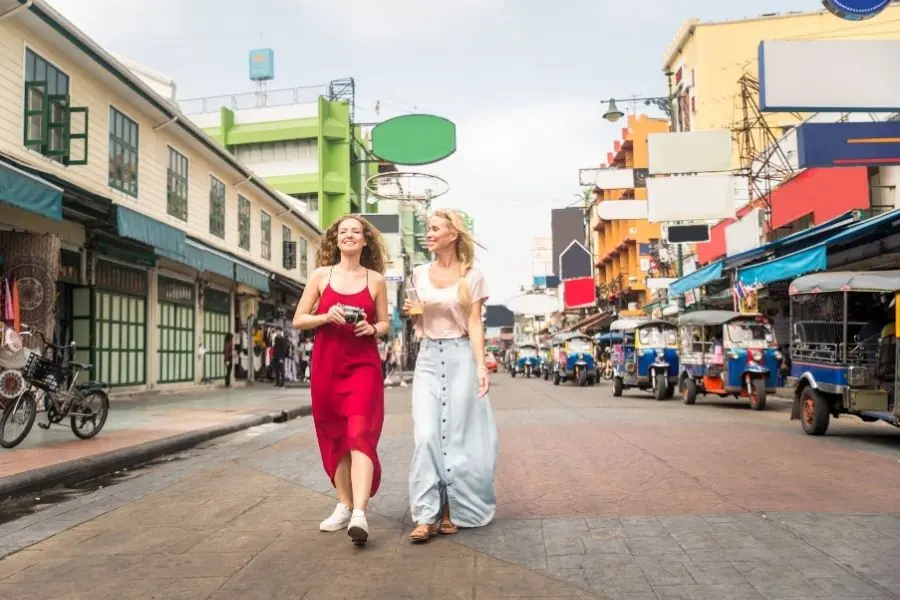
Khao San Road
Legendary, loud, loved and loathed in equal measure. Khao San Road is the backpacker landmark of the world: street food you cannot walk past, music at full volume, stalls selling everything, and an unmistakable bohemian energy.
Soi Rambuttri
Next door, Soi Rambuttri is the slightly calmer version, the same atmosphere with less of the racket.
Good to know
- Getting there: River boat to Tha Chang or Phra Athit pier (N13)
- Alternatively: bus or tuk-tuk from downtown
- Dress code: temples require shoulders and knees covered, and the Royal Palace requires trousers down to the ankle.
- Best for: first-time visitors, history lovers, families
Read Where to Stay in the Phra Nakhon area
Chinatown & Charoenkrung, the Bangkok Neighborhoods for Street Food and Creativity
This is the Bangkok you do not see coming, or rather, the Bangkok that catches you out every time. On one side Yaowarat, the most genuine and energetic Chinatown in Southeast Asia; on the other Charoenkrung, one of the oldest streets in the city, reborn as a serious creative and cultural quarter.
The contrast is the best part: cross one alley and you go from roaring neon and night stalls to a hushed design cafe looking out over the water.
What to see and do in Chinatown
Yaowarat Road after dark, Bangkok's best-known street food
When the sun drops, Yaowarat lights up: neon signs bounce off the wet asphalt, food carts take over every free corner, and the smell of dim sum, black-pepper crab and Thai desserts hangs in the air. It is a full-on sensory stretch of pavement and a required stop for anyone who cares about food.
Talat Noi, the hidden quarter
Just outside Yaowarat, this small historic pocket is a goldmine for photographers: very narrow lanes, bright street art and stacks of salvaged engine parts that give the place a strange charm, part Blade Runner, part open-air museum.
Warehouse 30 and The Jam Factory
Warehouse 30 is a multi-use space carved out of old port warehouses: art galleries, independent coffee shops, design stores. The Jam Factory is similar but greener and calmer, sitting right on the water. Together they are the new creative face of Charoenkrung.
River City and the Yodpiman River Walk
River City is Bangkok’s art and antiques mall, the right address if you are hunting for one-off pieces, or simply want to wander through serious galleries. The Yodpiman River Walk is a colonial-style promenade on the water, a few steps from the famous Flower Market (Pak Khlong Talat).
Ong Ang Canal
A former canal turned into a pedestrian strip: at weekends it fills with street art, crafts, live music and food stalls, busy without tipping into chaos. One of the most successful urban regeneration projects in the city.
Good to know
- Getting there: River boat to Si Phraya or Marine Department pier
- Alternatively: bus, taxi or MRT Hua Lamphong plus a short walk
- Yaowarat is better in the evening; Charoenkrung works at any hour
- Best for: food lovers, photographers, art and design fans, the curious
Read Where to Stay in the Chinatown area
Sukhumvit, the most modern of Bangkok's neighborhoods, and the expat favorite
Sukhumvit is the capital at its most modern, international and relentless. Sukhumvit Road runs east for kilometers, and every BTS Skytrain stop opens onto a different world: each pocket has its own identity, its own crowd, its own mood.
This is where you find the highest concentration of expats, design hotels, international kitchens and nightlife that is actually good. If you like cities that never wind down, you will be happy here.
The pockets worth knowing along Sukhumvit
Nana (BTS Nana)
Busy, multicultural, never dull. Nana is known for the sheer range of its kitchens: Middle Eastern, Indian, Korean and Thai restaurants alternate on every block. It is also one of the most recognizable, and noisiest, nightlife strips in the capital.
Asok (BTS Asok / MRT Sukhumvit)
The most practical junction on Sukhumvit, where the BTS and the metro cross. This is where you find Terminal 21, one of the more original malls in the city: each floor is dressed as a different world capital, from Rome to Tokyo. A strong base for day trips across Bangkok.
Thong Lo (BTS Thong Lo)
Bangkok’s fashionable address. Polished cocktail bars, top-tier restaurants (Japanese above all), members-only clubs and a crowd that mixes well-off expats with stylish young Thais. Come here for a smart night out.
Ekkamai (BTS Ekkamai)
The creative, hipster side of the Sukhumvit axis. Specialty coffee shops, cultural venues, W District (an open-air food court built for craft beer and street food in a sociable setting) and Gateway Ekkamai, a Japanese-themed mall with very good ramen. Calmer than Thong Lo, more alternative than Asok.
What to see and do around Sukhumvit
To get the most out of this area, open the evening with a cocktail over the endless Bangkok skyline at Octave or Tichuca Rooftop Bar. In daylight, go looking for emerging designers in the shops of Thong Lo and Ekkamai, then track down the night markets and the honest street food tucked into the side sois. Once it gets dark, let the district take over: this is the engine room of the city’s late-night scene, built for anyone who wants to keep going between hidden speakeasies, elegant lounge bars and the clubs everyone in Bangkok is talking about.
Good to know
- Getting there: buses and the BTS Skytrain, the whole Sukhumvit line
- Alternatively: taxis and Grab are easy to find anywhere
- Best for: digital nomads, couples, night owls, anyone after comfort and an international feel
Read Where to Stay in the Sukhumvit area
Bang Rak & Silom, the two-faced district, business by day and bars by night
Bang Rak and the Silom area are the commercial engine of Bangkok. By day this is the frantic business center of the city, filled with thousands of office workers.
Once the sun sets, though, it flips completely and turns into one of the main nightlife hubs in town.
What to see and do in Silom
Mahanakhon SkyWalk
Step out onto a glass floor more than 300 meters above the street. The famous “pixelated” tower has the highest and most dramatic 360-degree viewpoint in Bangkok. Time your visit for shortly before sunset.
Wat Sri Maha Mariamman (Wat Khaek)
An explosion of intricate carving and loud color in the middle of the concrete towers. This is the oldest and most important Hindu temple in Bangkok, a place of real devotion wrapped in the heavy smell of incense and fresh flowers.
Patpong and Soi Thaniya
The old, brash, instantly recognizable side of Bangkok after dark. Patpong is known for its busy evening market, while neighboring Soi Thaniya is the city’s “Little Tokyo”: a run of neon signs, izakaya and Japanese restaurants that hold their own.
Soi Convent and the food scene
A tree-lined, animated street where the culinary contrast is the whole point: you can move from long-standing street food carts that local reviewers rate, to the smartest bistros and cocktail bars in the district.
Good to know
- Getting there: BTS Sala Daeng or MRT Silom (the handiest interchange in the city)
- Atmosphere: the district is awake around the clock and everything you need is a short walk away
- Best for: anyone who wants transport on the doorstep, night owls, food lovers and business travelers
Read Where to Stay in the Silom area
Sathon, quiet elegance among Bangkok's neighborhoods
Sathon is the elegant, residential extension of neighboring Silom. If Silom is the loud commercial face of business, Sathon is the institutional one: this is where the embassies sit, along with the big luxury developments and silent tree-lined avenues. A few steps from the rush, it gives you an orderly, refined and well-connected Bangkok.
What to see and do in Sathon
Fine dining and a serious food scene
Sathon holds some of the best tables in Thailand. Whether you are after fusion cooking, gourmet Thai kitchens or more casual addresses that still cook properly, the standard here is high.
Lumphini Park
The city’s big green lung sits on the eastern edge of Sathon. It is the right place for a morning walk, a pedal boat on the lake, or simply sitting on the grass away from the pace of the streets. Bonus: you will spot the resident giant monitor lizards wandering between the trees.
Sky Bar at Lebua at State Tower
Made famous by The Hangover Part II, Sky Bar is one of the best-known rooftops on the planet. The cocktails cost as much as a full meal, but the view over the river and the Bangkok skyline at sunset earns it. Worth doing once.
The Robot Building and Sathon architecture
Sathon repays a walk for the buildings alone: the famous Robot Building (which really does look like a giant robot), modernist towers and period villas sit side by side in an odd, appealing mix.
Saphan Taksin pier
Central Pier (Saphan Taksin) is the main gateway to the Chao Phraya boats. From here the temples of Phra Nakhon, Chinatown and the Thonburi bank are minutes away. It is one reason Sathon is among the best-placed bases in Bangkok.
Good to know
- Getting there: BTS Saphan Taksin (Silom line), taxi
- Alternatively: every main river boat leaves from Sathorn pier
- Dress code: temples require shoulders and knees covered, and the Royal Palace requires trousers down to the ankle.
- Best for: couples, mid to high-end travelers, anyone who wants calm and polish without losing the connections
Read Where to Stay in the Sathon area
Thonburi & Khlong San, the Bangkok Neighborhoods Across the River
While the rest of Bangkok grew upwards in towers and malls, Thonburi chose to stay more or less as it was. That choice is exactly what makes it one of the most rewarding and genuine corners of the capital today.
On the west bank of the Chao Phraya, Thonburi is a tangle of canals (khlong), wooden stilt houses, quiet temples and markets that seem to have skipped the last fifty years. Add the recent creative push in Khlong San, with its fashionable restaurants and waterfront art venues, and you get a district that keeps catching you out.
What to see and do around Thonburi & Khlong San
Wat Arun, the Temple of Dawn
It is the emblem of Bangkok, the outline you recognize on any travel guide. The central tower (prang) is covered in fragments of colored porcelain that catch the low sun and almost dazzle you. Reaching it by boat from the opposite bank, with the Chao Phraya carrying its reflection, is a sight that stays with you.
The Thonburi canals by long-tail boat
The best way to understand Thonburi is to get on a long-tail boat and slip into the inner canals. This is the back of the city: laundry strung between temples, old men fishing from their own porch, children playing on the water. It is Bangkok before the asphalt, still going.
Baan Silapin, the Artist's House at Khlong Bang Luang
One of the loveliest and least-known corners of the capital. A century-old wooden house turned into a cultural center: you can drink a coffee, paint a traditional mask or watch a Thai puppet show (usually at 2 pm, except Wednesdays). The setting does the rest.
Kudeejeen, the Portuguese quarter
One of the odder pockets of Bangkok: an old quarter of Portuguese descent, with the church of Santa Cruz and its Khanom Farang, small cakes made to a recipe centuries old that you will not find elsewhere. Worth the detour.
ICONSIAM, the modern city on the water
On the Khlong San bank stands one of the most spectacular malls in Asia: an enormous building that holds, among other things, an indoor floating market. The contrast with the silent canals of Thonburi, a few minutes away by boat, is jarring and rather wonderful.
The Jam Factory and The Never Ending Summer
A former industrial warehouse converted into a creative hub on the water. Galleries, bookshops, coffee, and The Never Ending Summer restaurant, which serves refined Thai cooking in an industrial-chic room facing the river.
Good to know
- Getting there: river boat from Central Pier (Sathon) or any pier on the east bank
- Alternatively: BTS Krung Thon Buri or Wongwian Yai for Khlong San, taxi
- Timing: the canals are at their best early in the morning or late in the afternoon
- Best for: photographers, history lovers, couples, anyone looking for a Bangkok off the tourist trail
Siam & Pratunam, the Bangkok Neighborhoods for Serious Shopping
If Bangkok is the shopping capital of Southeast Asia, Siam and Pratunam are its center. The main Skytrain interchange is here (Siam station links the two BTS lines), which makes this the easiest base for anyone who wants to move around the city without friction.
The energy is high, the streets are always full and something is always happening. It is not an especially local area: it is built, openly, for people who want everything within reach.
What to see and do around Siam & Pratunam
Siam Paragon and the mega malls
Siam Paragon is the temple of luxury: international brands, a huge basement aquarium, IMAX screens and restaurants of every kind. Next door sit Siam Center (design and young fashion), Central World and MBK Center, known for electronics, gadgets and sports gear that will not empty your wallet.
Pratunam Market and Platinum Fashion Mall
The opposite of the luxury malls: people come here for rock-bottom rates on clothing, accessories and fabric. This is commercial, slightly chaotic Bangkok, but if you know where to look you will walk out with good pieces for very little.
Jim Thompson House
An unexpected pocket of calm in the middle of the noise. This beautiful teak house holds the Asian art collection of the American businessman Jim Thompson, who helped revive the Thai silk industry. The tropical garden around it lands as a shock after hours in the malls.
Baiyoke Tower II
One of the tallest buildings in Thailand. The observation deck gives you a full 360-degree view over the city, at its best at sunset or after dark. It is also one of the most popular places in town to see in the New Year.
Good to know
- Getting there: BTS Siam (the central station where the two lines meet)
- Alternatively: taxi, bus or tuk-tuk from downtown
- Best for: families, first-time visitors, shoppers, anyone who wants the easiest transport in the city
Read Where to Stay in the Siam and Pratunam area
Other Bangkok Neighborhoods Worth Exploring
Bangkok has plenty more to give if you have the time and want to step off the well-worn routes.
A few areas worth knowing:
Ari (Phaya Thai)
The quarter of local creatives: hipster coffee shops, independent galleries, few tourists and a lot of character. The right pick if you want to see the capital from the inside.
Bang Krachao
The green lung of the city, ten minutes away by boat. Bikes, canals, a weekend market and not a tower in sight. Half a day here resets you.
Koh Kret
A car-free island in the Chao Phraya, north of the city. Handmade pottery from the Mon community, food you will struggle to find elsewhere and the feel of a river village. A fine weekend outing.
Practical Tips for Moving Between Bangkok Neighborhoods
Choosing where to stay is only half the job; the other half is working out how to move. Here are the basics:
the fastest and most reliable way to move between Sukhumvit, Siam and Silom. It skips the traffic completely
covers the Hua Lamphong–Siam–Chatuchak axis, a good complement to the BTS
the best way to link Sathon, Chinatown, Phra Nakhon and Thonburi, cheap and easy on the eye
essential for the areas the trains do not reach. Always a better bet than a tuk-tuk over long distances
photogenic but a poor way to cross the city, fine only for short local hops
Mistakes to Avoid When Choosing a Bangkok Neighborhood
Picking a district on the hotel rate alone
A cheap room in Phra Nakhon might save you €20 a night and cost you hours in traffic if your plans put you in Sukhumvit every evening.
Underestimating Bangkok traffic
Two districts can look close together on Google Maps and still be 45 minutes apart by car at rush hour. Choose your area around the places you will actually go, not around the dot on the map.
Ignoring the BTS line when you book
The question to ask before confirming a hotel is not "where is downtown?" but "is there a BTS station within a 10-minute walk?"
Going to Yaowarat at lunchtime
Bangkok's Chinatown comes alive after dark. In daylight it is a hot, packed quarter without the neon that makes it.
Reaching the Phra Nakhon temples after 10 am in high season
The lines multiply and the heat turns punishing. Set out at 8 am and you will have the Grand Palace almost to yourself.
Ready for Your Perfect Bangkok?
No planning stress. Our team builds the itinerary around you, with private tours, licensed English-speaking guides and 24/7 support for the whole time you are in Thailand.
Which Bangkok neighborhood is best on a first visit?
On a first trip the strongest options are along the Chao Phraya River, the Silom hub (Sala Daeng), or the Siam area for transport. If your main goal is the Royal Palace and the historic temples, Phra Nakhon is the area to book.
Which area should you pick to stay away from the crowds?
Southern Sathon is an excellent choice, more residential and quieter. Other good options for a local feel are Ari (Phaya Thai), with its creative streak, or Thonburi for slow life along the canals.
Which area is best for getting around without taxis?
The Sukhumvit axis is hard to beat, thanks to the Skytrain (BTS) line that runs its full length. The Siam area (the central BTS interchange) and the Riverside piers (linked to BTS Saphan Taksin) also let you move on public transport and leave the traffic alone.
Where is the best place to stay in Bangkok for shopping?
Siam and Pratunam is the undisputed shopping ground. Luxury mega malls such as Siam Paragon sit next to the busy wholesale markets of Pratunam, all tied together by the central Skytrain station.
This guide may contain affiliate links: if you book through one of them, nothing changes for you, while we receive a small commission from the booking platform, which repays the time spent writing and updating this guide. More information.